What Is Hanja? How Chinese Characters Can Help You Learn Korean
Hanja shows up in a huge share of Korean vocabulary, but you don't need to study it like a scholar. Here's what's actually useful for learners.
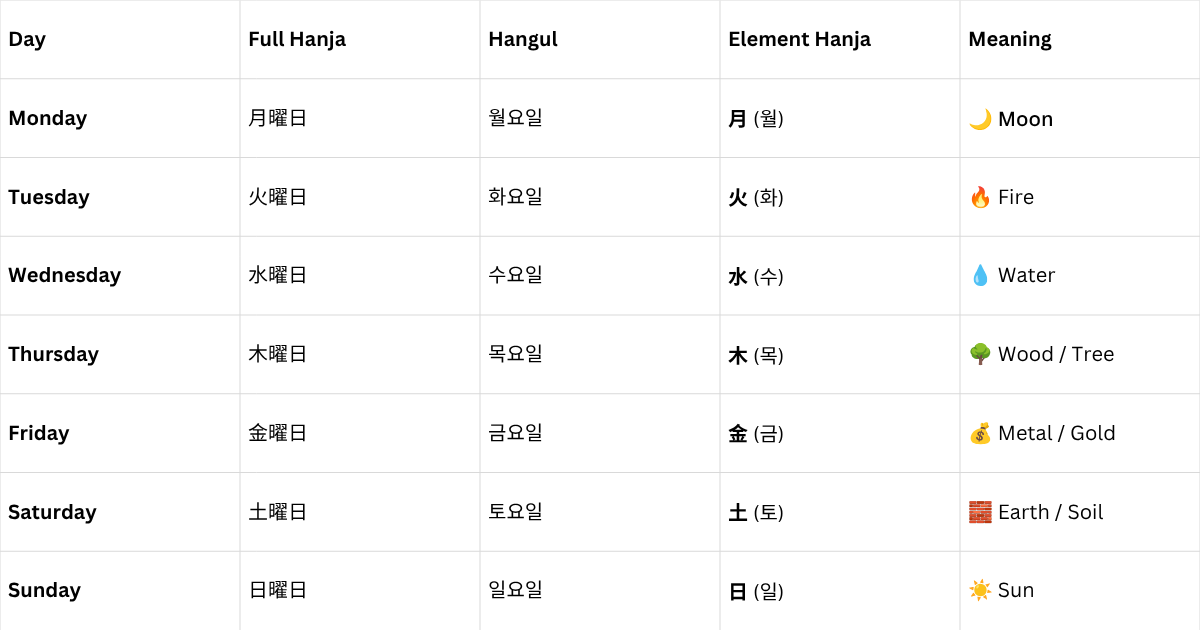
If you’ve encountered words like 학교 (學校), 전화 (電話), or 경제 (經濟), you may have noticed something: a lot of Korean vocabulary seems to be built from the same recurring pieces. For those of you who are also studying Japanese, you may have seen such characters in Japanese as well, called Kanji (漢字). That’s not a coincidence. Those pieces in Korean are called Hanja (한자). They’re Chinese characters that sit behind a huge share of Korean words.
Before you go any further: you do not need to become fluent in Hanja to learn Korean. Hanja isn’t a subject you add to your study list. Used right, it’s a shortcut that makes vocabulary you’re already learning easier to remember.
What is Hanja?
Hanja are Chinese characters that were historically used to write Korean. Modern Korean is written almost entirely in Hangul now, and Hanja barely shows up in everyday writing. One example I’ve encountered recently is on posters to announce Bloody Game participants. One was used to explain that Jeong Keun-woo is a former Baseball player. Despite Hanja being used rarely, a large portion of Korean vocabulary still has Sino-Korean roots, meaning many words were originally built from Hanja meanings even though you’ll rarely see the characters themselves in daily life.
Take 學校, which becomes 학교 in Korean:
- 學 = learning / study
- 校 = school
Put them together and you get 학교, which means school. You don’t need to be able to write 學校 or to be able to recognize the chinese version of the characters by hand to notice that pattern, and that’s the point.
Why does Hanja matter for Korean learners?
The real value isn’t reading ability. It’s pattern recognition. Once you know that 학 (學) means something related to learning or study, a whole cluster of words stops looking random:
- 학교 = school
- 학생 = student
- 학습 = learning / study
- 대학 = university
- 유학 = studying abroad
Individually, those are five separate vocabulary words to memorize. Once you see 학 running through all of them, they become one idea with five variations. That’s the shortcut.
You don’t need to learn Hanja like a native scholar
This is the part most guides get wrong. Your goal isn’t to read historical documents or reproduce stroke order for 學. You’re not learning calligraphy, rather, you’re learning to notice a recurring root and roughly what it points to.
That means learning:
학 = study / learning
is enough. You don’t need the character’s full history, every reading it’s ever had, or its formal written form. For a beginner or intermediate learner, the vocabulary connection is the useful 90%; the rest is a rabbit hole you can skip (unless you’re learning Chinese or Japanese at the same time).
And if you’re still translating Korean in your head, understanding roots like these can actually help you move past that. See How to Stop Translating Korean in Your Head.
What should you actually focus on?
If you want a rough order of priorities, it looks like this:
1. Recognize recurring Sino-Korean roots 학, 전, 화, 생, 문, 국, 인, and a handful of others show up constantly.
2. Learn the Korean vocabulary attached to them don’t study a root in isolation; study it through real words you’ll actually use.
3. Notice compounds as they form 학 + 생 → 학생, 학 + 교 → 학교. Seeing the combination is what makes the system click.
4. Understand broad meaning, not exact translation you don’t need to catalog every word that might contain a given root.
Learn the Korean word first, Hanja second
Here’s a mistake worth avoiding: seeing 學 and thinking you need to memorize the character before you’re “allowed” to learn 학교.
You don’t. Learn 학교 = school the normal way, the same way you’d learn any vocabulary word. Then, later, when you notice 학교 and 학생 share 학, that connection reinforces what you already know.
Hanja works best as reinforcement for vocabulary you’re already acquiring, not as a prerequisite subject standing in front of it.
Important warning: not every Korean word comes from Hanja
Korean vocabulary comes from several sources, not just one:
- Native Korean words
- 사람 (person), 먹다 (to eat), 하늘 (sky), 물 (water)
- Sino-Korean vocabulary
- words built from Hanja roots, like 학교 or 전화
- Loanwords
- 커피 (coffee), 컴퓨터 (computer), 인터넷 (internet), 택시 (taxi)
- Borrowed from other languages, especially English
- You already know most of them if you know how to read Hangul
- Newer or mixed formations
- 갓생 is a slang that combines the English word for God (갓) and the Hanja (Chinese) character for life 生 (생). It means living an exemplary, highly productive, and disciplined life
- Words that don’t fit neatly into any one category
If you start assuming every Korean word has a Chinese character quietly hiding behind it, you’ll end up confused and frustrated hunting for roots that were never there. Hanja explains a lot of Korean vocabulary, but not all of it. For example, 학세 contains 학, but it’s not for the Sino-Korean term for school. It means Schweinshaxe, which is a German culinary dish.
Hanja isn’t the same thing as Mandarin
One more important distinction: Hanja are Chinese characters, but Sino-Korean vocabulary is Korean vocabulary, with Korean pronunciation and Korean grammar. Knowing how a character is pronounced in Mandarin tells you nothing reliable about how the Korean word sounds.
學, for example, has different readings depending on the language reading it. What actually matters for you as a Korean learner is the Korean reading and the Korean word built from it, not an attempt to reverse-engineer Mandarin through the back door.
How to start using Hanja without overwhelming yourself
You don’t need a formal study plan for this, but a light structure helps:
Week 1 = Learn 5 common roots (학, 전, 화, 국, 생 is a solid start).
Week 2 = Find 5–10 Korean words you already know, or want to know, that contain them.
Week 3 = Start noticing the roots while reading or reviewing vocabulary. Notice when they show up.
Week 4 = Try predicting the meaning of an unfamiliar compound before looking it up.
Try it now: you know 학 relates to learning or study. 자 means person. What might 학자 mean?
…
학자 means scholar. Literally, roughly, “a person of learning.” If you got close, that’s the whole system working exactly as intended.
How much Hanja should you learn?
Be skeptical of any claim that a fixed number of Hanja unlocks a fixed percentage of Korean vocabulary. Those stats get thrown around a lot without solid sourcing. What’s safe to say is this: for most learners, a relatively small set of recurring roots already provides real, useful vocabulary connections. You don’t need to memorize thousands of characters to get the benefit. A few dozen well-chosen roots will change how you see Korean vocabulary.
A beginner’s starter list
A reasonable set of high-value roots to start with:
| Root | Broad meaning | Examples |
|---|---|---|
| 학 (學) | learning | 학교, 학생 |
| 전 (電) | electricity | 전기, 전화 |
| 화 (話) | speech / story | 대화, 전화 |
| 국 (國) | country | 한국, 국가 |
| 생 (生) | life / birth | 학생, 생활 |
| 문 (文) | writing / culture | 문화, 문학 |
Treat these as learning aids, not exact one-to-one translations, as the precise meaning can shift depending on what a root is combined with.
So, should you learn Hanja?
Yes, if you’re an intermediate learner who enjoys understanding how Korean vocabulary fits together, it makes memorization noticeably easier and more durable.
No, in the sense that you don’t need it to become conversational. Plenty of fluent speakers never formally study Hanja at all.
If your immediate goal is speaking, prioritize high-frequency vocabulary, listening, and actual speaking practice first. Hanja is a supporting tool that makes vocabulary easier to organize and remember, not a gate you have to pass through to get there.
For practical speaking practice you can start today, How to Practice Korean Speaking Alone is a good next step.
The Ultimate K-Drama Romance Bundle
450+ Korean words, phrases, and sentences across three levels, plus a bonus guide with romance speaking scenarios.
Get the Bundle →